Most pruning damage is done with good intentions. A practical guide to the three cuts that keep a tree healthy and the ones to avoid.
Trees are forgiving, but not endlessly so. After twenty years of pruning other people's trees — and a few of my own, badly — I have come to believe that most damage comes not from neglect but from over-enthusiasm. A tree pruned badly in one afternoon can take a decade to recover.
The right time
Most trees are best pruned in late winter, while dormant. Exceptions: stone fruits (cherry, plum) in summer to avoid silver leaf, and maples and birches in late summer or autumn, because they bleed heavily in spring. If in doubt, prune less and later rather than more and earlier.
Three cuts, no more
Almost all of the pruning I do is one of three cuts. First, remove dead, diseased and crossing branches — the hygiene cut. Second, remove branches that rub against each other or grow back into the centre of the crown — the airflow cut. Third, shorten a branch back to a healthy side shoot to control size — the shaping cut. That is the whole vocabulary.
The cut itself
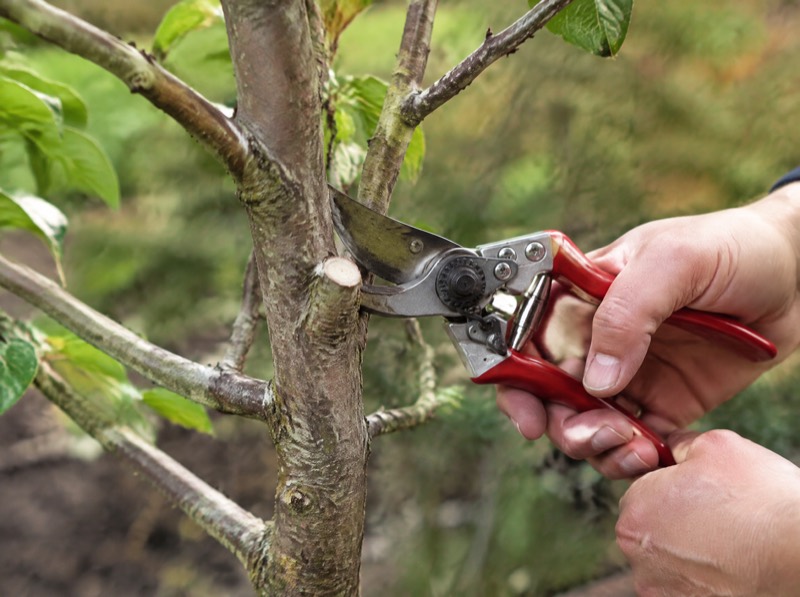
Make the cut just outside the branch collar — the slight swelling where the branch meets the trunk. Do not leave a stub, and do not cut flush into the trunk. The collar contains the tree's own sealing tissue, and cutting into it is what creates wounds that never quite heal. Use a sharp saw, and let the weight of the branch do the work.
What not to do
Do not top a tree. It is the single most damaging thing a gardener can do: it creates a mass of weak regrowth, invites decay, and ruins the shape permanently. Do not paint wounds — modern arboriculture agrees the tree seals better without. And do not remove more than a quarter of the living canopy in one year.
Watch, then cut
Walk around a tree for a full season before pruning it. Most of what looks like a problem in February has resolved itself by June. The best pruners I know spend more time looking than cutting — and their trees show it.