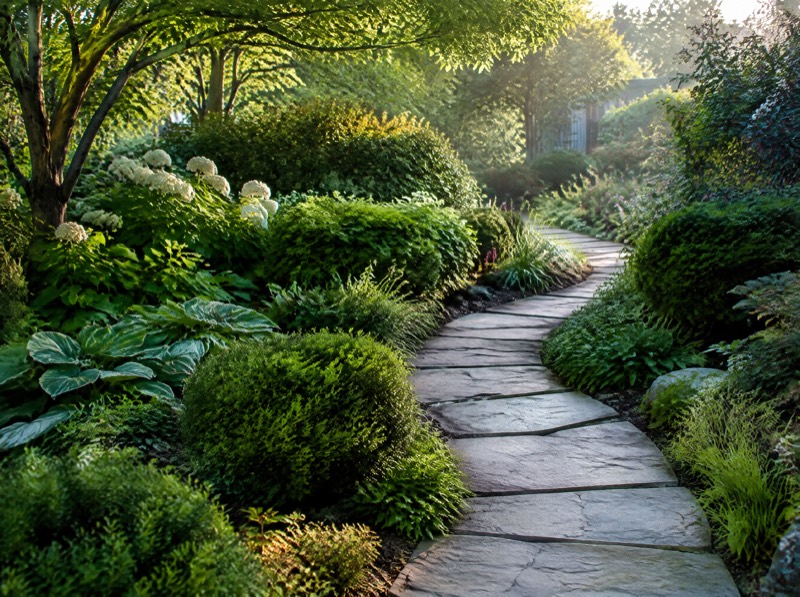
The path is the first thing a garden asks of you. On stone, gravel, moss and making a route that invites a slower pace.
A garden path is not transport infrastructure. It is an invitation. The best paths do not get you from the gate to the door as fast as possible; they take you the long way, turn once for no reason, and make you slow down. In a shaded garden, where the pleasure is in detail, the path is half the design.
Curves, but not too many
A path should curve for a reason — around a tree, towards a view, along a border. A path that wiggles decoratively is a path that annoys you by the second season. Draw it with a hosepipe, walk it for a week, then adjust. The route you take in the rain is the true route.
Choose a surface that suits your feet
Stone slabs are beautiful and expensive; set them with generous gaps and let moss and thyme fill in. Gravel is cheap and noisy and needs edging; it also announces visitors, which is either charming or not. Stepping stones through a moss lawn are my favourite: minimal, cheap, and they force a deliberate stride.
Widen at the places you stop
People naturally pause where the path widens. Make a small widening at the best view, the oldest tree, the bench. A path that is the same width everywhere is a corridor; a path that breathes is a garden.
Let it weather
New stone looks new. Within two years the moss arrives, the edges soften, and the path begins to look like it was always there. Do not seal it, do not pressure-wash it, and do not sweep it too clean. The weathered surface is the finished surface.
A good path is walked without thinking about it and remembered afterwards. That is a low bar and a high one at the same time — and it is worth getting right.